
Why Sleep is So Important for Your Health
Recently
Why Sleep is So Important for Your Health
Sleep is a foundational pillar of health. Everyone knows it, but few people today get truly high-quality rest every night. It’s not just about how much you sleep, how well you sleep matters even more.
Sleep is paramount because it’s when your body runs deep cellular repair and restoration. Think of sleep as your own “Wolverine healing cycle” that mends the day’s micro-damage. Biologically, that includes processes like cellular autophagy (cell recycling), apoptosis (programmed cell turnover), glymphatic drainage, and more - cleaning up damaged components and replacing them with new ones. Below is a list of the top cleanup processes going on during high-quality sleep:
- Clears brain waste (glymphatic drainage): Sleep increases cerebrospinal fluid exchange to clear metabolites, such as β-amyloid.
- Recalibrates synapses and consolidates memory: Sleep down-scales excess synaptic activity, allowing for better memory retention + learning ability.
- Runs autophagy and maintains proteostasis: Circadian-tuned recycling clears damaged proteins and organelles to keep cellular quality control on track.
- Activates DNA-damage responses: Sleep increases chromosome dynamics and repair processes that reduce accumulated neuronal DNA damage.
- Keeps apoptosis targeted + effective: Sleep supports anti-oxidative, pro-repair states so apoptosis removes truly compromised cells without collateral loss.
- Drives tissue repair (Growth Hormone axis): Early slow-wave sleep pulses growth hormone that supports protein synthesis, collagen formation, and tissue remodeling.
- Rebalances autonomic tone (HRV): Non-REM favors parasympathetic activity, which helps restore cardiovascular flexibility.
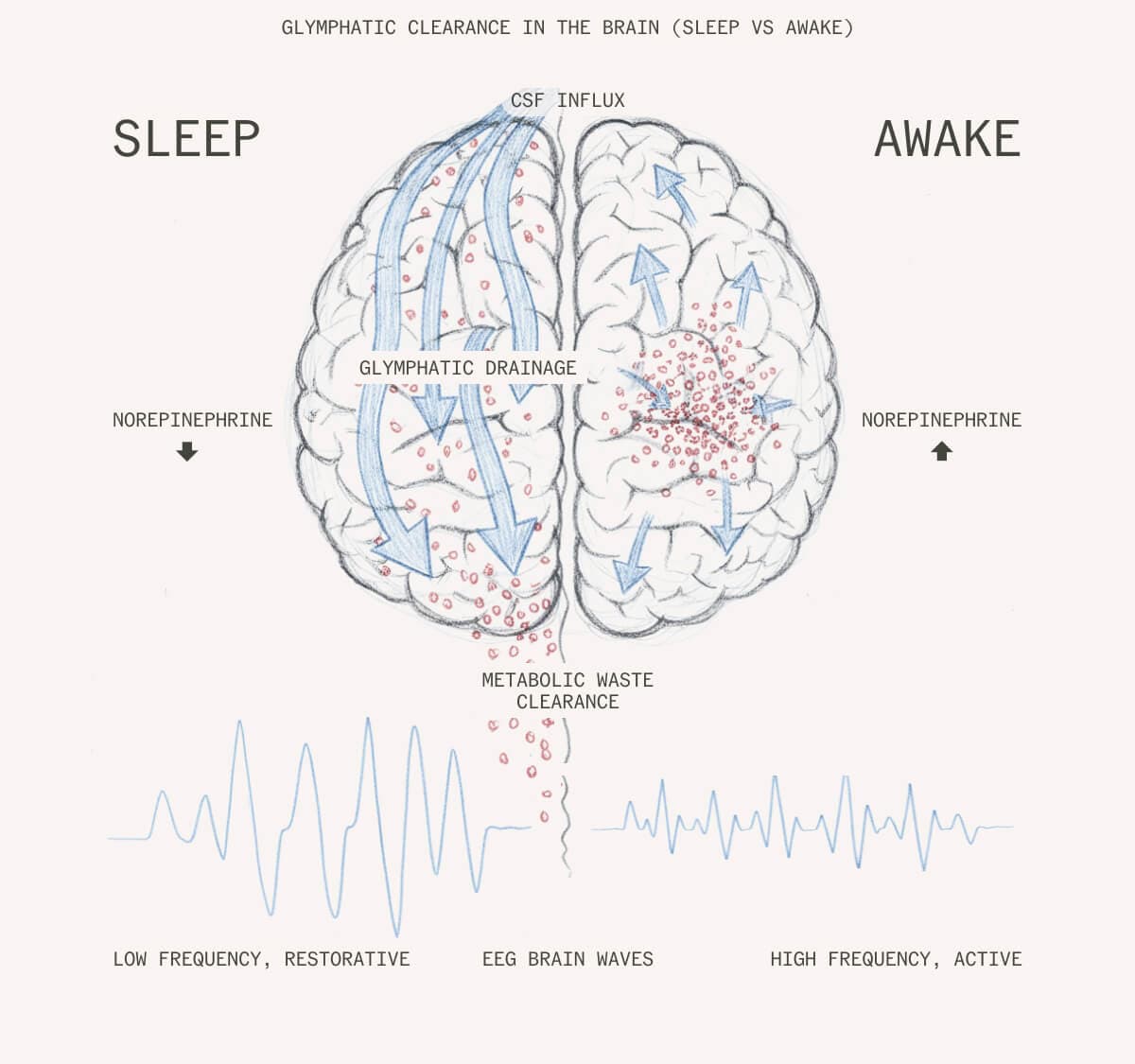
Sleep is clearly not just time to rest, it is also time for our body to perform cellular maintenance, systems cleanup, and next-day performance. It is actually incredible just how much damage control is going on every night we hit the sack.
The issue today is that because of our environment and lifestyle habits, many of these processes are not running as robustly as they should. We do not repair daily cellular damage as effectively, and over time, that adds up, raising the risk for chronic problems.
On a cellular level, every day is a battle, and when the nightly repair shift underperforms, the balance tilts the wrong way.
The good news is that simple habits can transform sleep quality and give your body what it needs to repair at full capacity.
Light, Melatonin, and Your Internal Clock
Getting a good night’s sleep starts with synchronizing your circadian rhythm,aka your body’s internal clock. Like any fine-tuned system, your body’s timing is extremely important. Imagine trying to properly execute trillions of cellular reactions when the timing isn’t very precise!
Your body is always using input signals from its environment to understand what time of day it is and where on the planet you are. If it knows that information, it can fine-tune all of the biological processes running in your body to be optimized for that exact environment. These input signals are known as “zeitgebers”, German for “time-givers”. The most important zeitgeber for synchronizing our body’s clock is light.
Of all the wavelengths of light, blue light is the master clock signaler. Blue light has high-energy wavelengths that signal wakefulness and stimulation (ideal for daytime). However,when exposed to blue light at night, it can severely disrupt our circadian rhythm and thus sleep.
Blue wavelengths (like those from daylight, LEDs, and screens) can suppress melatonin 3 to 4 times more than the same brightness of warmer red or orange light.
Blue light at night tricks your brain into “daytime mode,” delaying the natural rise of melatonin and pushing back your natural onset of sleep, and thus the vitally important cellular repair processes.
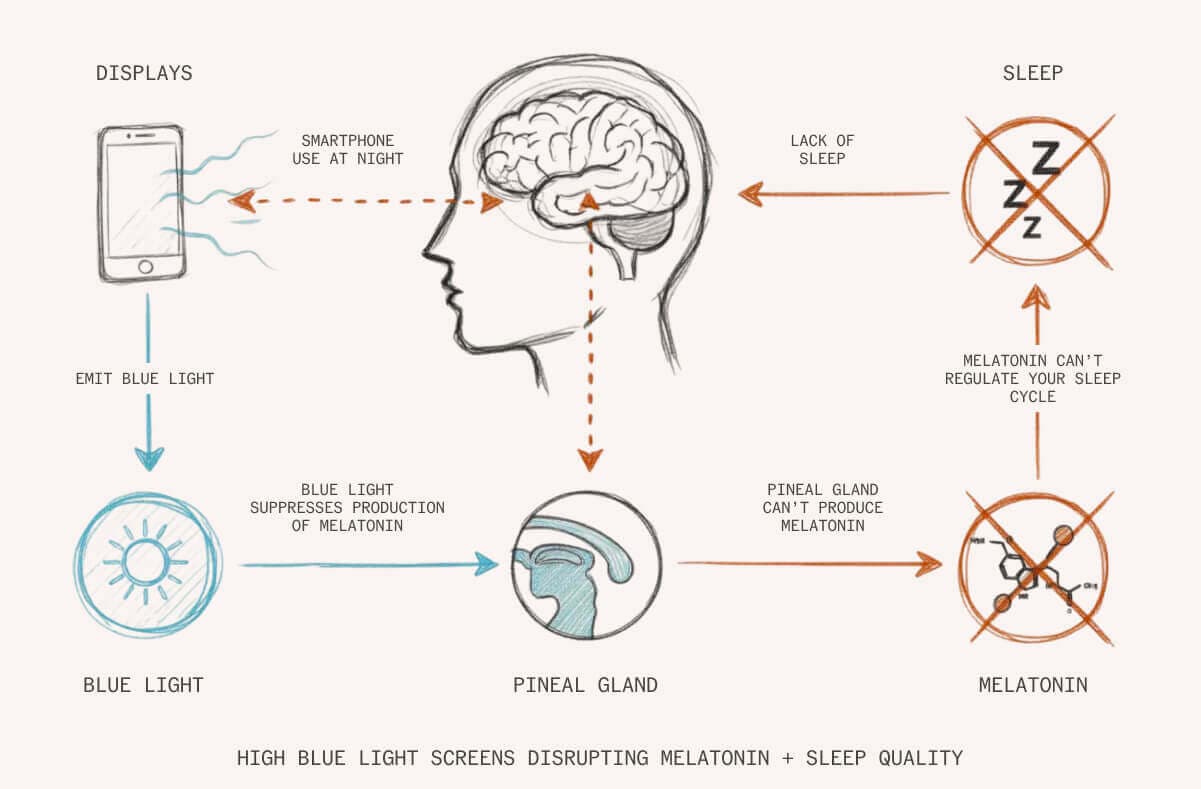
FUN FACT · Why Blue Light Has Such a Strong Effect? Specialized cells in our eyes (melanopsin-containing retinal cells) are most sensitive to blue light and send signals to the brain’s master clock (the suprachiasmatic nucleus) to regulate the circadian rhythm.
Moreover, it’s not just the color of light but also the intensity and angle that matter: bright light of any color can reduce melatonin. A study (see chart below) found that 2500 lux light at nighttime had up to a 69% reduction in melatonin concentration vs a 500 lux light of the same color.